NATCA Recognizes Scholarship Winners: Riley Lancaster
Every year, NATCA offers a scholarship program for spouses, children, stepchildren, and legally adopted children of active, retired, and deceased members in good standing for at least two consecutive years. This scholarship is for full-time attendance at accredited colleges and universities within the United States and its territories for an undergraduate degree program.
Last year’s prompt asked candidates to examine the factors that can either strengthen or weaken labor unions.
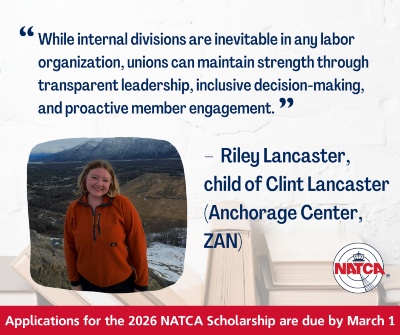
Riley Lancaster, child of Clint Lancaster (Anchorage Center, ZAN) is among last year’s 20 winners. Read the essay that Riley submitted below:
Labor unions are most effective when their members stand together, but achieving unity can be challenging due to differing perspectives, priorities, and external pressures. Several factors contribute to division within unions, including ideological differences, generational gaps, varying job classifications, and external political or economic influences. However, strong leadership and strategic organizing can bridge these divides and foster a sense of solidarity.
Unions represent workers across multiple job roles, industries, or experience levels. This leaves a considerable amount of people and workers. These groups may have differing priorities, such as wage increases versus job security, which can create internal friction within the union. A second factor that can create rifts in unions is a generational and cultural divide. Older workers may prioritize pension security and job stability, while younger members might focus on wage increases and career mobility, especially with how the newer generations have come up. Cultural and linguistic diversity can also create barriers to communication and trust within a community such as a union. A third factor that can create division within a union is political and ideological differences. Members may have different views on broader political issues that intersect with labor policies, such as healthcare, immigration, or environmental regulations, leading to internal disputes. Nowadays, the country seems divided among all things; not everyone will be pleased with the political and economic ways of unions. A final factor that can divide unions is the way of leadership. If union leadership is perceived as distant, unresponsive, or overly bureaucratic, members may feel disconnected from the decision-making process, reducing engagement and trust.
Having a unified and strong union, some strategies to create these characteristics revolve around being trustworthy among the members. Leadership must ensure open dialogue, keeping members informed through regular meetings, newsletters, and digital platforms. Social media in this age is a great way to reach out to the members. Encouraging member feedback and participation in decision-making fosters trust, which a union must have to be strong and unified. Education and solidarity-building programs and conferences are other ways to inspire and unite the workers. Workshops on labor history, workers’ rights, and collective bargaining can build a shared sense of purpose. These opportunities and programs can also bridge gaps between older and younger workers. It can be challenging to ensure the members are heard regarding decision making. Ensuring fair representation of diverse groups within union leadership and using democratic voting processes like representative voting for major decisions can make members feel valued and heard. Strong, approachable leadership that actively engages with workers on the ground can increase unity. Organizing committees that include representatives from various worker demographics can help address diverse concerns. When addressing external influences, unions must combat misinformation and employer tactics by providing fact-based resources and fostering an internal culture of trust. Political neutrality or a balanced approach to advocacy can also help prevent ideological rifts, mainly when the country is as divided as it is on political and economic issues.
While internal divisions are inevitable in any labor organization, unions can maintain strength through transparent leadership, inclusive decision-making, and proactive member engagement. By fostering a sense of collective identity and shared purpose, unions can overcome challenges and remain a powerful force for worker advocacy.
We’re currently accepting applications for 2026-2027 students! The deadline is March 1, 2026. Find more information on eligibility requirements and how to apply at www.natca.org/community/scholarship-application/.
